A

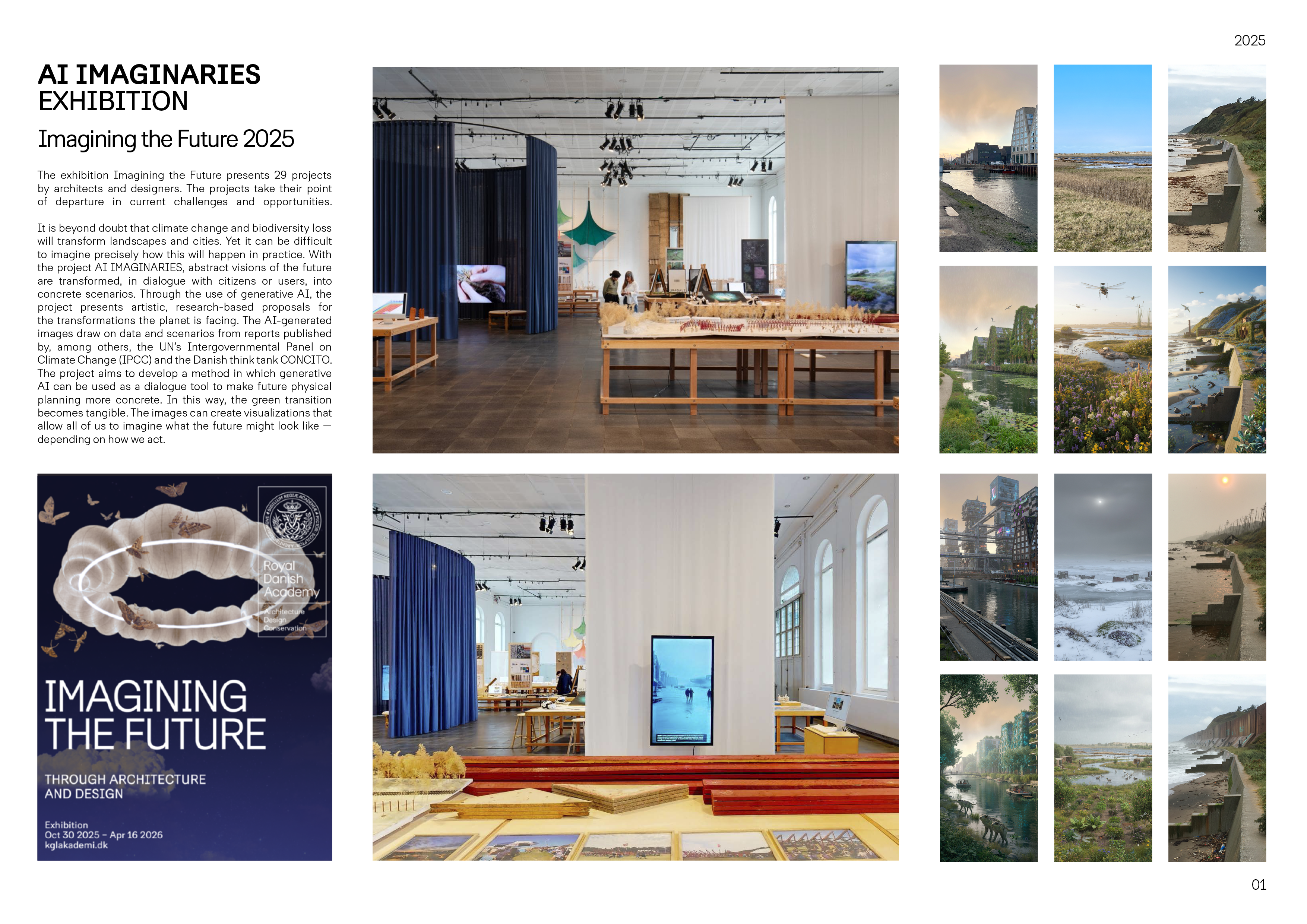
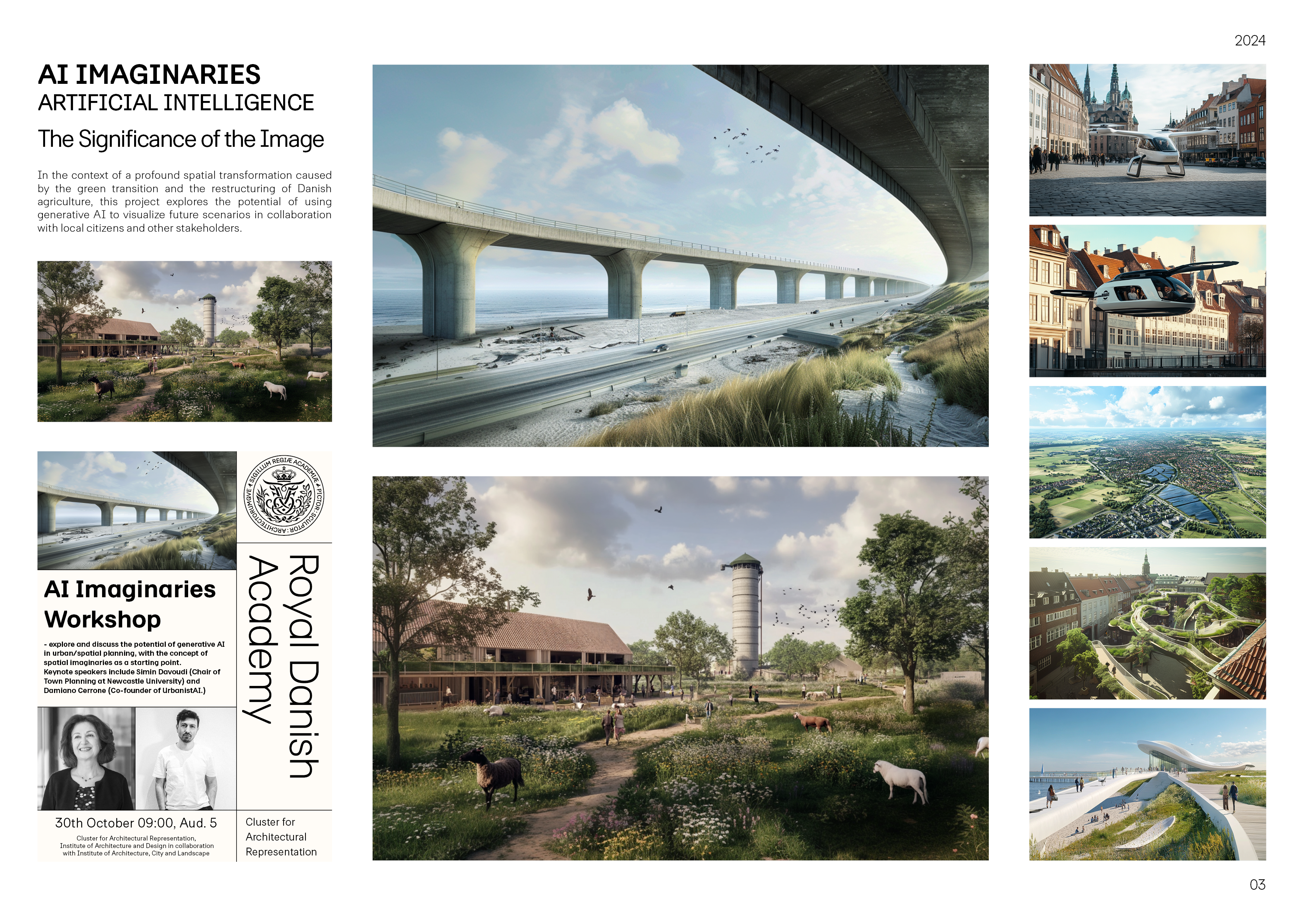
Our project explores AI-driven artistic research to reimagine climate futures. An exploration of future imaginaries with a point of departure on changing spatial conditions in the face of the cli-mate crisis, the biodiversity and the environmental crisis.
These imaginaries are based on collective aspirations, probing widespread iconography, and con-cerns for the future of humankind and life on Earth.
The material submitted for the exhibition is based on data and scenarios presented in reports on climate change and the green transition such as the IPCC Assessment Reports & the Global Assess-ment Report on Biodiversity and Ecosystem Services and in a Danish context the CONCITO report The Land Use of Denmark – The Future of Denmark. The development of such images will be used to consolidate a methodology involving generative AI in spatial planning processes, where such images can be used to engage in dialogue with citizens to help to visualize the spatial consequences of the green transition.
AI Imaginaries at "Imagining the Future" exhibtion
The Royal Danish Academy:
Anders Hermund, Gustavo Ribeiro, Nikola Gjorgjievski
External collaborators:
University of Copenhagen — Department of Geosciences and Natural Resource Management
University of Copenhagen — Department of Computer Science
University of Copenhagen — Department of Anthropology
The Pioneer Centre for Artificial Intelligence
Aalborg University — Department of Sustainability and Planning
Newcastle University
CONCITO
UrbanistAI
Vandkunsten Architects
Schønherr
Danish Urban Planning Laboratory


This project will apply deep learning in the research domains of epidemiology, architecture, and remote sensing on multi-scale data, spanning from the level of the individual household to the metropolitan level to identify risk areas of mosquito-borne diseases in East African cities. The urban malaria vector Anopheles stephensi recently started spreading across East Africa, posing a major health risk to urban populations. While the links between housing conditions and mosquito-borne diseases are increasingly recognized, the relation between attributes of urban environments and vector-borne diseases remains understudied, decreasing the efficacy of measures to address health issues in African cities. This project will address the aforementioned knowledge-gap by investigating the relationship between mosquito densities in households and architectural, ecological, and urban form variables in Dar es Salaam, Tanzania. The study will include household surveys of mosquito densities and housing conditions as well as high-resolution geospatial surveys of urban areas. The study will conduct statistical data analyses of the links between mosquito densities in households and indicators derived from the household and neighborhood surveys. The findings will be utilized in automated analysis of multispectral satellite remote sensing imagery based on deep learning models trained with manually delineated attributes of the urban environments to identify risk areas of mosquito-borne diseases at an unprecedented detail. The predictive performance of the risk assessment model will be evaluated and the results will be used to guide policy priorities and interventions in addressing mosquito-borne diseases. The research will be integrated in teaching programs at the Royal Danish Academy and the University of Copenhagen. The project thus has potential to address important knowledge gaps, enhance urban resilience in Africa, and strengthen Danish biomedical data science capacities.
PI: Royal Danish Academy
External collaborators:
University of Copenhagen - Department of Geosciences and Natural Resource Management
University of Copenhagen - Department of Computer Science
London School of Hygiene & Tropical Medicine
Ifakara Health Institute in Tanzania.
Risk-assessment of Mosquito-borne Diseases Based on Remote Sensing and Deep Learning
Funded by Novo Nordisk Foundation
The project aims to develop an AI-based method for evaluating architectural design and renovation in collaboration with modl.ai, a company specializing in AI agents for automated game testing. By integrating artificial intelligence with our existing digital dialogue tool Virtual Scenario Responder, the project seeks to simulate user experiences and thereby efficiently optimize spaces for diverse needs.
The Royal Danish Academy aims to establish a workflow in which AI systems can be trained on data from real users with varying accessibility requirements. This will enable a testing model capable of faster and more comprehensive evaluations of architectural quality.
The overall objective is to create a broad positive impact in the construction sector by promoting improved accessibility and universal design in the built environment for all.
Anders Hermund (PI)
Nina-Franziska Helmich Christiansen (Project Coordinator)
External collaborator: Christoffer Holmgård Modl.ai
Method for Evaluating Universal Design Using an AI-Driven Dialogue Tool
The project is funded by Realdania
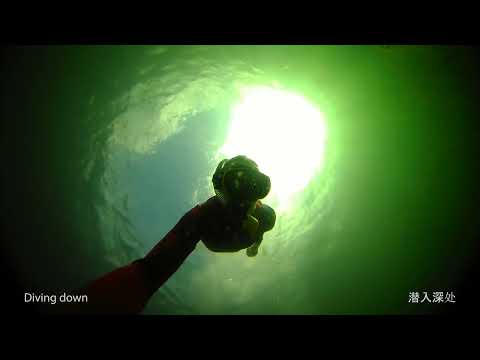
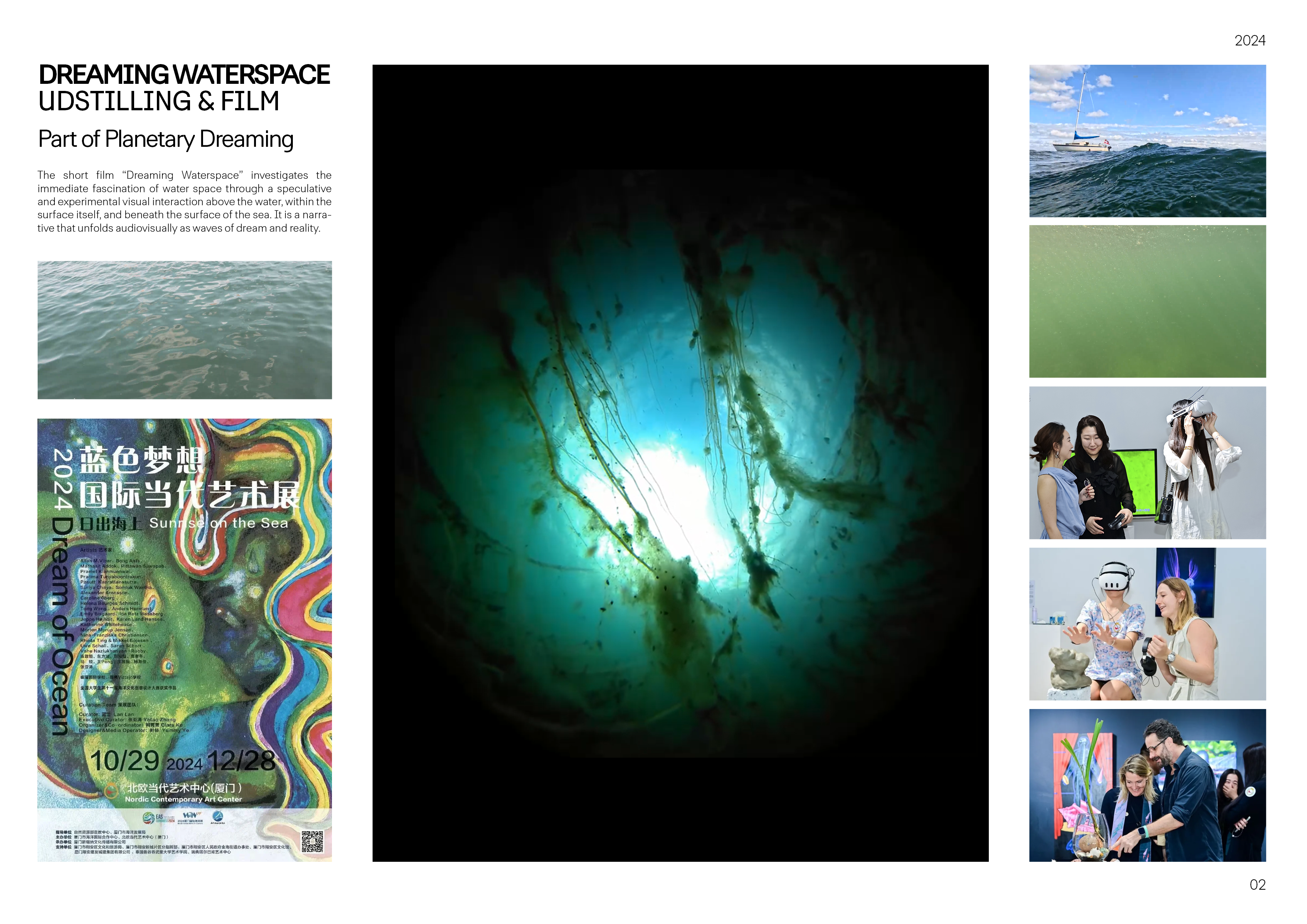
The short film “Dreaming Waterspace” is made by Anders Hermund and presented first time at the Xiamen Nordic Arts Centre in November 2024.
With this short film, we aim to delve into a fascination with the realm of water through a speculative and experimental visual interaction. This journey takes place above the water, on its very surface, and beneath the sea’s depths.
The story unfolds as an audiovisual expression, where waves of dreams and reality blend. It depicts a gradual submersion of body and thought beneath the surface, entering a weightless state that encourages reflection and fosters wondrous reflections of the human body’s movements in the universe.
By gazing through the mirror-like waters of Copenhagen Harbor into the churning depths of the Øresund, we invite the viewer to join us in dreaming and to see the world through the eyes of water. This experience allows glimpses into the different relationships individuals have with this element, shaping their lives on Earth.
“Dreaming Waterspace” is a playful associative sequence about water and the space that exists above, within, and beneath it, experienced as a phenomenon.


In this publication, Anders Hermund and Kirsten Marie Raahauge contributed the chapter “Perspectives on Images: Imagery as a form of cognition and practice,” developed with input from Jan Bäcklund, Knud Romer, Madame Nielsen, Søren Ulrik Thomsen, and Bjarke Ingels.
The chapter reflects on images not simply as representations, but as active modes of inquiry and knowledge production.
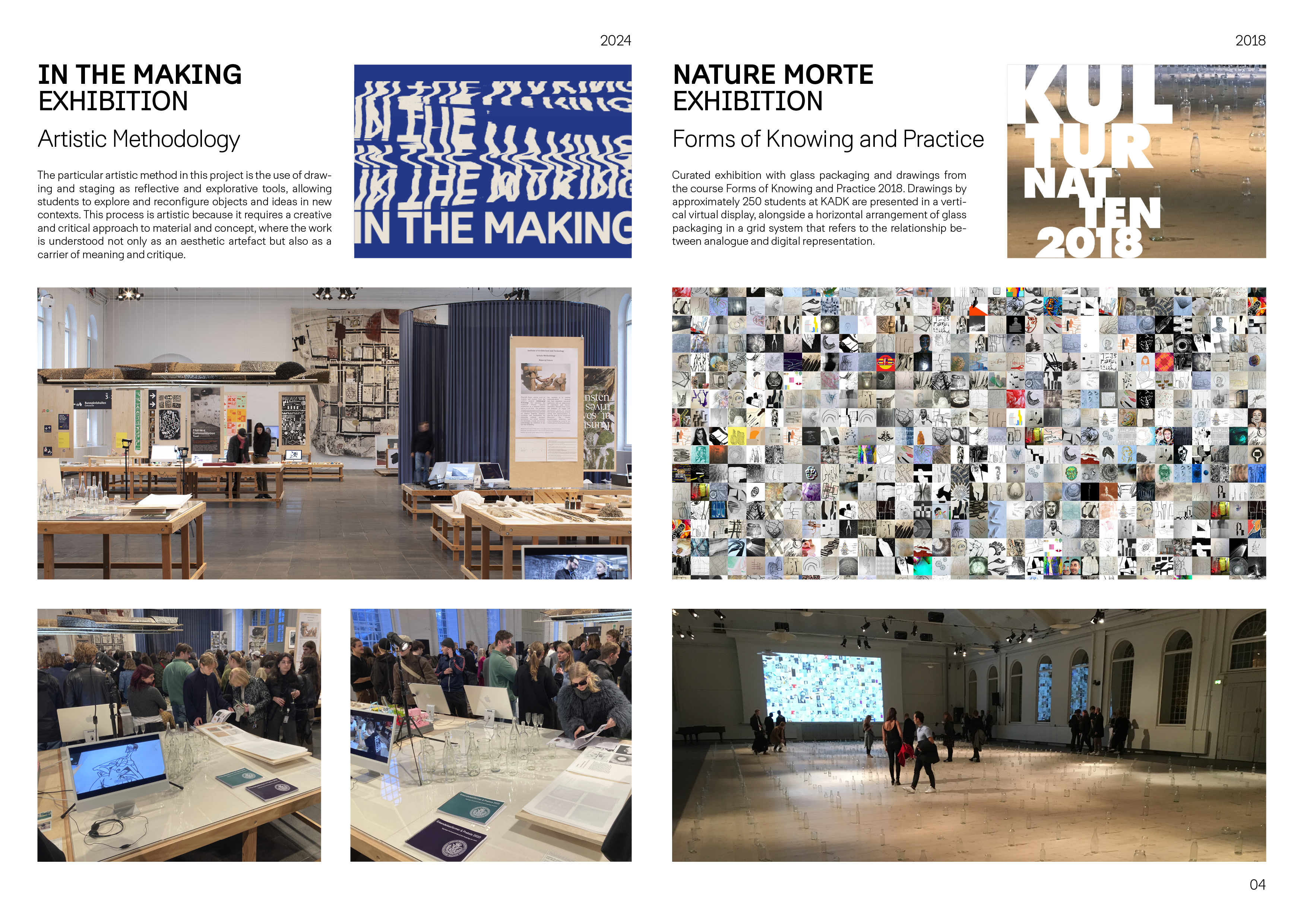
The publication accompanies the exhibition In the Making – Artistic Methods in Architecture and Design, which presented 26 projects by students and researchers together with a series of films, and highlighted how artistic methods can support interdisciplinarity, sensory engagement, and the imagining of positive futures in times of major societal change. My contribution to the exhibition, Forms of Cognition and Practice, grew out of the teaching format of the same name, in which around 200 first-year students explore how the world can be understood through creative practice.
The exhibition also marked the culmination of the Erkendelsesformer og Praksis (Forms of Cognition and Practice) trajectory and brought together a wide range of interesting collaborators.
External collaborators:
Anne Knudsen - Anthropologist and Editor-in-Chief
Line Falk - Designer
Tommy Petersen & Christian Bretton-Meyer - Artist group A-Kassen
Jan Bäcklund - Bureaugrapher and artist
Louise Hindsgavl - Designer and artist
Henrik Oxvig - Philosopher
Christina Capetillo - Photographer
Knud Romer - Author
Kristian von Hornsleth - Artist
Per Aage Brandt - Author, semioticician, professor and philosopher
Peter Carlsen - Artist
Kristoffer Albris - Associate Professor
Madame Nielsen - Dramatic playwright, actor, musician and author
Thomas Kluge - Artist
Søren Ulrik Thomsen - Poet
Susanne Hangaard - Designer and ceramic artist
Anna Weber Henriksen - Artist
Claus Carstensen - Artist, author and curator
Katrine Wiedemann - Director
Maja Ravn - Scenographer
Benjamin Hav - Musician
Bjarke Ingels - Architect
Victor Buchli - Anthropologist
Frederik Dirks Gottlieb - Film & Podcast producer
Sebastian Aristotelis - Architect
Karoline Lyngbye - Film director
Louise Foo - Musical artist