


A

In Zanzibar, architect and researcher Otis Sloan Wood is asking whether the hospital building itself can protect patients from malaria and dengue fever. His Ph.D. is titled Unbitten: Preventing hospital-acquired mosquito-borne disease through adaptations to the built environment. It is part of the five-year the MBD-Free (Mosquito-Borne Disease Free) project, a collaboration between the Royal Danish Academy, the University of Copenhagen, the State University of Zanzibar (SUZA) and several other Tanzanian educational institutions and universities.
"Hospitals are places where many people from across communities meet and congregate," Otis Sloan Wood explains. An infected mosquito may bite patients waiting in a hospital, who then carry the disease back to their home communities, where it can spread further. The risk is greatest for those who are already vulnerable. "If you go into a hospital, perhaps you're giving birth, and then you get malaria on top of this, that can be very serious."
From extreme environments to Zanzibar
Sloan Wood's route into the field began with a master's degree at the Royal Danish Academy at the programme Architecture and Extreme Environments. His thesis project was set in Lanzhou, China, "slap bang in the middle of China", which at the time was one of the country's most air-polluted cities.
"That really got me interested in this relationship between the built environment and public health. All the decisions we make when we're designing the built environment have health impacts. They make healthier choices easier to make, or they can increase the risk of being exposed to certain diseases."
The interest also has a personal root. Otis Sloan Wood, originally from the United Kingdom, says his mother and sister both work for England’s National Health Service. "I've always been really interested in health and incorporating that into architecture."
Since 2018 he has worked in Tanzania and on other projects in sub-Saharan Africa and south-east Asia. On the Star Homes project, he was one of the architects based locally, coordinating the design and construction of the houses.
Led from Zanzibar, shaped by hospital users
Part of what drew Otis Sloan Wood to the MBD-Free project is the project team. “The majority of the researchers involved in that project are Zanzibari or Tanzanian. That’s part of the reason why I wanted to participate, because of the focus on collaborating with those people based in the region, hopefully promoting more long-term and sustained impact.”
“These interventions are led by the needs of the people that use the hospitals, rather than what we as researchers think they need. It’s informed by the literature, but it’s also informed by the experience and the knowledge of those that use the hospital, who know the hospital much better than me who goes to visit and sees it through this kind of architectural lens.”


Sloan Wood sees the problem more as a web of relationships that impact each other. This also leads to a more diverse set of solutions, none involving building entirely new hospitals. He contrasts this with top-down disease control, using mosquito nets as his example; They are very efficient when used correctly, but often uncomfortable and not designed around how people live.
Small interventions with potential for big impact
The team calls the result "a suite of interventions". Otis Sloan Wood explains it as "lots of small changes in the hospitals that we think together could have a big change. We have some early data, but not really rigorous data on their efficacy."
The first group of interventions targets mosquitoes breeding in the hospital grounds. Culex mosquitoes typically breed in dirty water, like sanitation systems, so the team has insect-proofed the sanitation systems in and around the hospitals.
The second group of interventions addresses heat in the wards. The wards have good doors and screened windows, but they become so hot that patients keep the doors open, potentially letting mosquitoes in. The team has planted climbing plants on cables to shade a large test wall and installed a fan by every bed instead of one big fan in the middle of the room. "By increasing the comfort of the patients, we hope to reduce the need for them to open the windows and doors to create entry points."


The third group of interventions rethinks where people wait. Hospitals typically have one ground-floor waiting area for patients and the family members of those on the wards, a buffet for mosquitoes who are attracted to CO2 in our breath, body heat and odour. The team turned the hospitals' largely ornamental landscape into shaded garden waiting areas, with space for staff meetings and for families. A six-month post-occupancy evaluation at one hospital showed that around a third of those waiting now did so outdoors.


Showing the research on video
Otis Sloan Wood also communicates the project through video, and he is clear about why. "In one minute, you can give a glimpse into a context where someone has never ever been before and may never go." A few seconds of footage convey the sound and the activity, and "the busyness, the light, which transports you there. I also find it slightly more honest than a photo – especially polished architectural imagery."
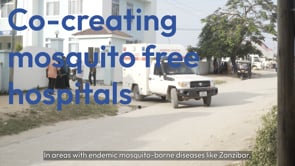
His own two-minute film on the project (above) won an award in a journal's research video competition, where the one rule was that no AI could be used to generate material. "It's such a simple way to understand the project, much easier than trying to describe it with words."
Climate change makes this research even more relevant
Otis Sloan Wood, who defended his Ph.D. thesis this fall, will continue working in Zanzibar on the project as a postdoc. They are by no means finished, and his research could become even more relevant in coming years as the climate changes.
Climate change, alongside increased global travel, exchange of goods, et cetera, is increasing the habitat range of various mosquitoes that can carry diseases. The mosquito that can carry dengue was recently found breeding in East London for the first time.
That raises the question of whether the findings could be used elsewhere, for example in southern Europe. Otis Sloan Wood would rather export the methods from the project than the specific designs. "Our approach is specific to Zanzibar, and you might want to do something else in southern Europe, where the architecture is different. I’m skeptical of the search for one-size-fits-all solutions that can be copied from place to place. Some principles and methods do travel well, but the designs themselves should be adapted to each context."
His stance on mosquito-borne diseases is equally pragmatic. Rather than aiming for elimination, which seems unrealistic, Sloan Wood suggests creating built environments that help communities live well while reducing their risk of exposure.
"We obviously don't want people to get these diseases. However, the likelihood is they're going to always be around, and we need to find ways in which we manage them in a safe and sustainable way rather than completely eradicate them." As an architect, he looks for solutions that improve environments or address not just practical needs, but cultural, recreational or social needs.
"The built environment has a role, but it's obviously not the silver bullet. We need to have these layers of different prevention," says Otis Sloan Wood.


