A

My research explores the design, analysis and realisation of advanced structural systems where geometry, material behaviour and construction methodology are inseparable. I study how structural performance can be designed through form, kinematics and fabrication logic - bridging engineering rigour with architectural intent and computational workflows.
Across my projects, I have investigated deployable structures, origami-inspired facade systems and form-efficient shell structures, including work on brick shells of Eladio Dieste, with a consistent interest in how geometrically driven design enables lightweight, materially efficient structures.
Past research in deployable structures examined kinematics and connection designs: how folding, hinging and geometrical constraints govern motion, stability, stiffness development and load paths as systems transition from compact to deployed states. The studies of origami facades expand this theme into building enveloped, focusing on how folding patterns can provide adaptive shading, dispersion of reflected solar radiation for pedestrain comfort. In parallel, my work on Gaussian vaults of Dieste investigates thin, form-active masonry systems and the structural logic of curvature - connecting historical precedents with modern analysis and design tools.
Methodologically, I combine analytical modelling (kinematic and equilibrium formulations; simplified mechanical models), numerical simulation (non-linear FEM, stability/buckling assessment, sensitivity studies), and experimental validation (physical prototypes, component testing, and/or full-scale demonstrators when feasible). Parametric and algorithmic modelling supports rapid exploration of geometry-performance relationships, while fabrication-aware constraints ensure research outputs remain grounded in realistic construction scenarios. Overall, the aim is to develop high-performance, materially responsible, and architecturally expressive structures - offering transferable principles for future adaptive facades, efficient shells, and deployable building systems.
CFD modelling of indoor climate in rural sub-Saharan African houses (BOVA Network: Pump-Prime Projects) investigated how low-cost architectural decisions influence airflow, thermal conditions, and indoor–outdoor CO2 transport—key factors in understanding how mosquitoes may locate human hosts and why transmission can persist despite bed-nets and indoor interventions. The project aimed to build a robust design-support tool grounded in computational simulation and calibrated against real measurements.
A core strand of the work used computational fluid dynamics (CFD) to study CO2 dispersion and exchange through building envelopes under different architectural configurations. Simulations focused on indoor–outdoor boundaries typical of rural housing and compared façade typologies (including wood, bamboo, and shade-net), with attention to how permeability and gap patterns shape the spatial distribution of CO2 at openings and façade surfaces. The modelling work also incorporated bed-net effects using porous-jump boundary conditions tuned to match target airflow attenuation behaviour, enabling more realistic prediction of velocity drops and gas transport around sleeping areas.
A second strand delivered a field measurement campaign to address a key limitation: the need for empirical data to verify and refine CFD assumptions. A purpose-built test house in Mtwara, Tanzania was instrumented with multiple CO2 sensors, airflow sensors at openings, indoor air temperature and ground temperature probes, humidity and radon monitoring, and an external weather station. Data were logged over several days at high frequency to capture day–night patterns and occupant presence during sleeping periods.
Verification work compared CFD predictions against measured CO2 values and evaluated how geometric abstraction (e.g., simplified roof detail and removal of experimental equipment representations) influences predictive performance. Results showed that higher-detail models reduced discrepancy, while an abstracted model remained sufficiently accurate for future parametric investigations, including planned exploration of how house dimensions and configurations affect CO2 distribution and ventilation performance.
My research in Conservation aims to reduce uncertainty in preventive conservation by linking measurable material behaviour to predictive models of damage. I combine conservation perspectives with engineering methods to understand how climate, handling, and structural constraints act on complex heritage objects over time.
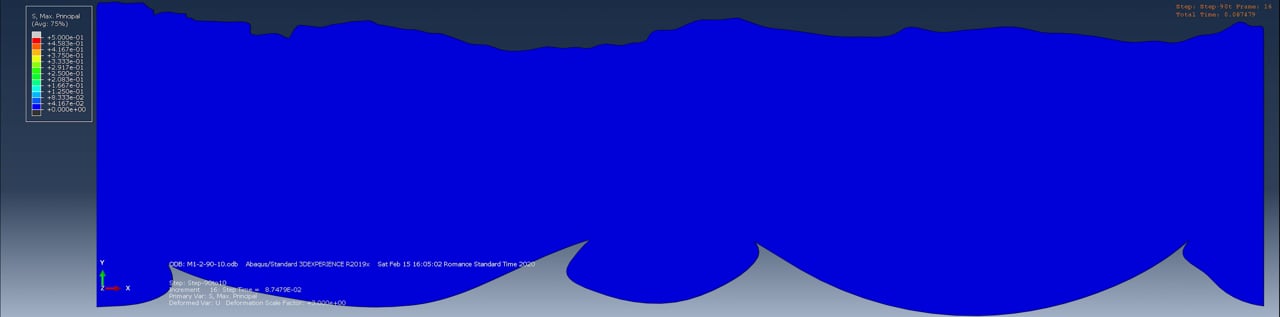
A major strand of my work is the numerical simulation of oil canvas paintings, treated as layered composites with strongly coupled mechanical and moisture-driven responses. Because relative humidity changes can trigger swelling and shrinkage, paintings experience time-dependent stresses that are influenced by layer properties, geometry, and constraints. I develop computational frameworks that represent these interactions in three dimensions and across broad humidity conditions, enabling systematic evaluation of how key parameters; elasticity, swelling and shrinkage coefficients affect deformation patterns and stress concentrations. This provides a basis for explaining why certain paintings crack or deform under specific environmental histories.
Beyond reproducing global deformation, the simulation is oriented toward damage mechanisms. By analysing where and when stresses localise, the work supports hypotheses about crack formation and growth, and it helps frame testable conservation questions (e.g., which fluctuation amplitudes, rates, or sustained conditions increase risk). The broader objective is to translate simulation outputs into decision support for conservation practice, including risk-informed climate specifications and clearer communication of uncertainty and vulnerability for stakeholders.