A

Acoustic foam is primarily made from petroleum-based plastics that cannot be recycled. In architectural acoustics, they are mainly applied as absorptive, add-on materials, often after spatial design decisions have been made.This project develops graded biofoam, a material cast from industrial by-products, as a sustainable alternative for architectural acoustics. By combining robotic fabrication with acoustic simulation, the material composition and surface geometry are tuned to the specific sound conditions of a room, embedding acoustic behavior directly within material and fabrication processes rather than treating it as an add-on.

Polyurethane foam is the default acoustic material in the building industry. It is cheap, widely available, and reasonably effective at mid and high frequency absorption. However, it is also petroleum-derived, non-biodegradable, and manufactured through a chemical process that produces significant embodied carbon. At end of life, it cannot be meaningfully recycled, meaning most PU foam is landfilled or incinerated.
This project proposes biofoam as an acoustic material. Formulated from gelatin, glycerol, and natural fillers, every input is bio-based or byproduct-derived. Unlike PU foam, the biofoam can be composted rather than landfilled at end-of-life.
The base formulation of the developed biofoam consists of gelatin as the binder, glycerol as a plasticizer, and two foaming agents that control density and porosity. Onto this base, three filler conditions were tested: tree bark, wood flour, and cotton. Each filler interacts differently with the foam matrix, affecting porosity, density, and surface texture, which in turn affects both acoustic absorption and mechanical stiffness.


Acoustic Testing
Each foam recipe was tested for sound absorption using an impedance tube. A sample of the foam is placed in the tube, exposed to sound at varying frequencies, and the resulting absorption coefficient is measured across the spectrum. This produced a distinct absorption curve for each recipe, allowing direct comparison of how filler type and density affect performance.
Impedance Tube Analysis was carried out at the Center for Material Studies (CEMAS)
Mechanical Testing
Alongside acoustic performance, each recipe was tested for mechanical stiffness using a compression testing machine. Filler type emerged as the dominant variable affecting stiffness, more so than binder ratio or foaming agent.


Acoustic foam typically targets a specific frequency range. The acoustic testing revealed that each biofoam peaks at a different frequency. This became the premise of the grading system: if different recipes peak at different frequencies, then distributing them strategically across a single single panel could produce collective coverage that an individual recipe does not achieve alone.
Digital simulation confimed that broad absorption across the speech band target range emerged from the spatial organisation of multiple recipes.


The surface geometry of acoustic panels is a direct expression of its function. A foam panel's surface geometry directly affects how it interacts with incoming sound, and two parameters govern this relationship: material depth and surface amplitude.
Depth determines low-frequency absorption. Sound at lower frequencies carries longer wavelengths, which penetrate further into a porous material before being converted to heat. Increasing material thickness extends absorption down the frequency range, allowing the foam to engage wavelengths it would otherwise miss. This is why absorption depth is frequency-dependent: each target frequency implies a minimum material thickness to perform against it.
Surface amplitude governs scattering. A flat foam surface reflects incoming sound specularly. An articulated surface breaks this up, redirecting sound across a wider range of angles and producing a more even distribution of energy in the room.
Together, these two parameters give the foam's surface geometry its acoustic logic. A panel zone that needs to absorb low frequencies is thick; a zone that needs to scatter mid frequencies has relief sized to match.


Festsalen as a Building Typology
The Festsalen at the Royal Danish Academy was selected as a case study because it represents a broader building typology: the multi-purpose institutional hall, a space used for lectures, exhibitions, performances, and gatherings. It is the kind of space where acoustic performance is perpetually compromised by the requirement to serve everything. This condition is not specific to the Festsalen, but for ceremonial spaces found in institutional buildings everywhere.
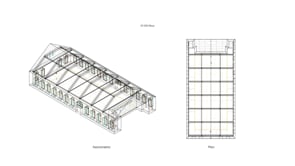
To analyse the current state of the building, an acoustic surface analysis is generated using the Pachyderm Plugin for Rhino/Grasshopper. The analysis makes the acoustic behavior of the room visible as a spatial map.

The surface mapping can be applied to any intervention placed within it. In this case, the A-frames that the Royal Danish Academy already owns and regularly uses for various scenarios happening in the Festsalen. The project thus works with existing resources: the A-frames become the hosts for the biofoam panels, positioned within the room according to where the simulation identifies the greatest acoustic need.
Running the surface mapping across the placed panels produces a set of speech clarity values showing how acoustic conditions vary across the panel's own surface. That map is then translated directly into a foam distribution map. High-clarity zones receive diffusing recipes, low-clarity zones receive absorbing recipes, which is all data derived from previous acoustic and mechanical testing.


The same simulation data that determines recipe assignment across a panel also drives its physical depth. By reading the frequency distribution of sound energy at each zone from the simulation output, the required absorption depth per zone can be calculated directly.


To evaluate the biofoam panel system across a range of real conditions, three usage scenarios were simulated within the room: a lecture, a workshop, and a combined multi-use configuration running both simultaneously.
The lecture scenario places a single source at one end of the room with receivers distributed across the listening area. The acoustic targets are to reduce echo, scatter remaining sound, and preserve direct sound from source to listener. After panel placement, reverberation time was reduced more effectively than an equivalent configuration of PU foam panels.
The workshop scenario distributes multiple source-receiver pairs across the room, reflecting the close-range, multi-directional nature of group work. The acoustic targets shift accordingly: the priority is reducing overall reverberation and supporting speech intelligibility at short range. Panel placement in this configuration achieved Early Decay Time (EDT) reduction within the target range across both source positions.
The multi-use scenario had two simultaneous speech sources operating in the same reverberant field, with listeners under both. Speech definition exceeded the 50% threshold under both single and simultaneous source conditions, and reverberation was reduced within the target range in both cases.


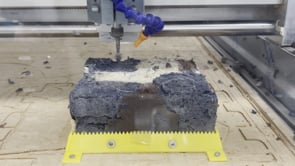
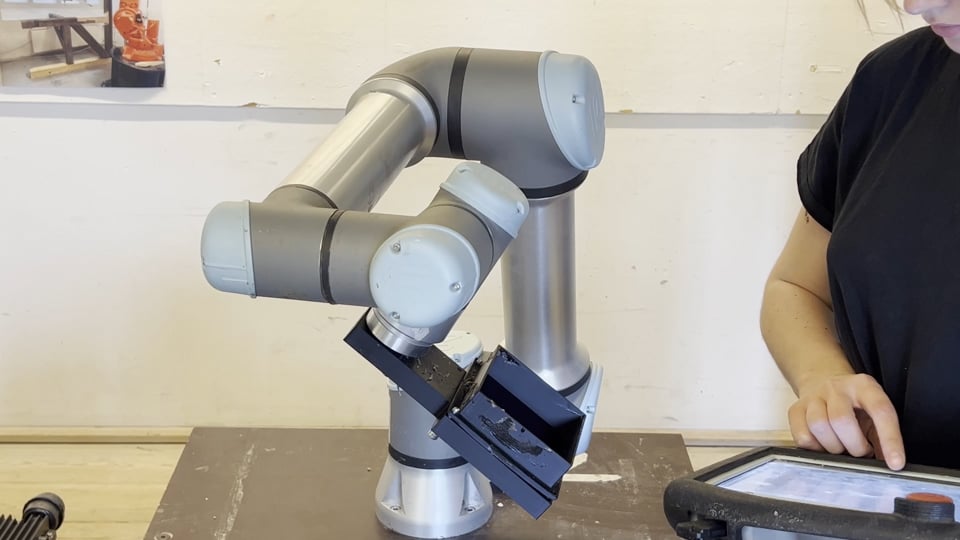
The fabrication section introduces a two-factor robotic process: robotic casting to establish the digitally simulated foam placements within the mould, and CNC milling to refine the surface geometry according to frequency-depth targets.

Robotic casting is performed using a UR5 robotic arm fitted with a custom end-effector. The mould is held at a precisely controlled angle while each foam recipe is poured in sequence, allowing different compositions to settle and partially cure into distinct zones before the next is introduced, making it a repeatable and precise movement.
Once cured, the panel moves to CNC milling. A tungsten carbide tool paired with a compressed air cooling system directed at both tool and foam throughout milling managed to keep the material stable during the process. The milled surface realizes the depth and amplitude targets set by the simulation. Each zone is cut to its specified profile, translating the acoustic data into physical geometry.