A

This research investigates architectural material intelligence derived from the natural properties of wool. By combining craft, data, and digital technologies, it demonstrates how machine-knitted components can mediate between body and environment through climate-responsive movement, proposing a passive approach to environmental control.
Meet A Hygromorph explores how architecture can become responsive through the inherent properties of materials rather than mechanical systems. The project investigates architectural material intelligence derived from wool, demonstrating how machine-knitted textile components can mediate between body and environment through climate-responsive movement. By combining craft, computational design, and digital fabrication, the research proposes a passive approach to environmental control where responsiveness is embedded directly within the material itself.
Rather than understanding architecture as a static object, I have in this thesis envisioned built environments as dynamic systems that continuously negotiate relationships between occupants, materials, and atmospheric conditions. The project asks how architecture might actively participate in environmental adaptation through its material behavior.


The project emerged through an iterative process of making, testing, and observation. A series of knitted prototypes were developed and exposed to moisture in order to investigate how different structures, fiber compositions, and material configurations responded to changing environmental conditions.
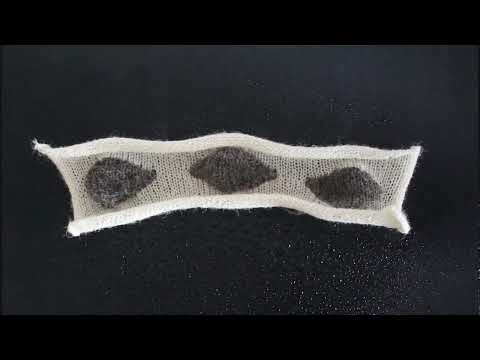
Many experiments failed to produce meaningful movement, while others revealed unexpected behaviors. Through repeated testing, a hygromorphic system capable of controlled curling and spatial transformation was identified and refined. The research combines traditional textile knowledge with computational workflows and digital fabrication, demonstrating how material behavior can become a design driver rather than a constraint.
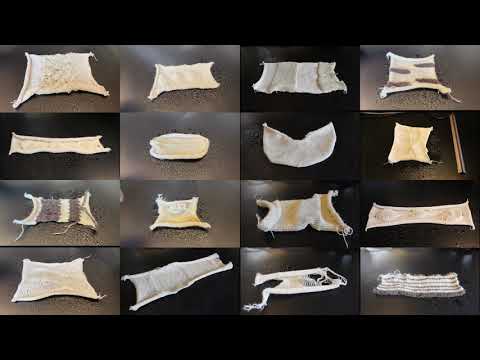
At the core of the project is a hygromorphic textile system that reacts to changes in atmospheric moisture. As humidity fluctuates, the knitted components expand, contract, and reconfigure, altering the permeability of the architectural envelope.

The system responds not only to broader environmental fluctuations but also to human presence. As visitors move through the pavilion, their bodies contribute heat and moisture to the surrounding air, becoming active participants in the continuous transformation of the space. Through extensive material experimentation and computational development, the project demonstrates how biological principles can inform adaptive architectural systems.

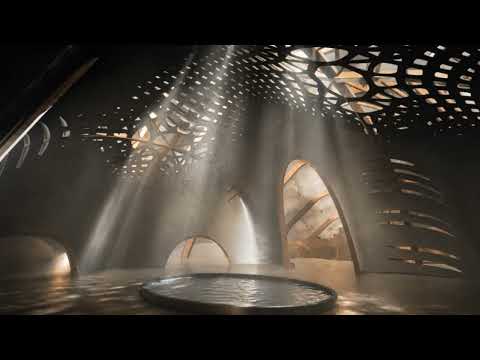
The architectural proposal is designed as a sequence of interconnected microclimates that gradually transform environmental conditions and sensory perception. Moving through the pavilion, visitors encounter changing levels of light, humidity, temperature, and airflow before entering the central hygromorph chamber. Here, the responsive textile envelope continuously adjusts in response to both atmospheric conditions and human occupation.

The resulting environment is never entirely fixed. Instead, space emerges through an ongoing dialogue between material behavior, environmental change, and human presence. Subtle shifts in openness, airflow, light, and tactile qualities create an architecture that is experienced as a living and evolving atmosphere rather than a static enclosure.
As buildings become increasingly dependent on energy-intensive technologies to regulate indoor environments, this project proposes an alternative approach rooted in material performance. By treating materials as active participants rather than passive building components, the project suggests new possibilities for architecture that is adaptive, resource-conscious, and environmentally responsive.

The project challenges conventional notions of architecture as a fixed and stable construct, proposing instead an architecture capable of change, negotiation, and interaction. In doing so, it contributes to ongoing discussions about sustainable design and demonstrates how future built environments may achieve comfort, adaptability, and experiential richness through material intelligence alone.