A


ABSTRACT
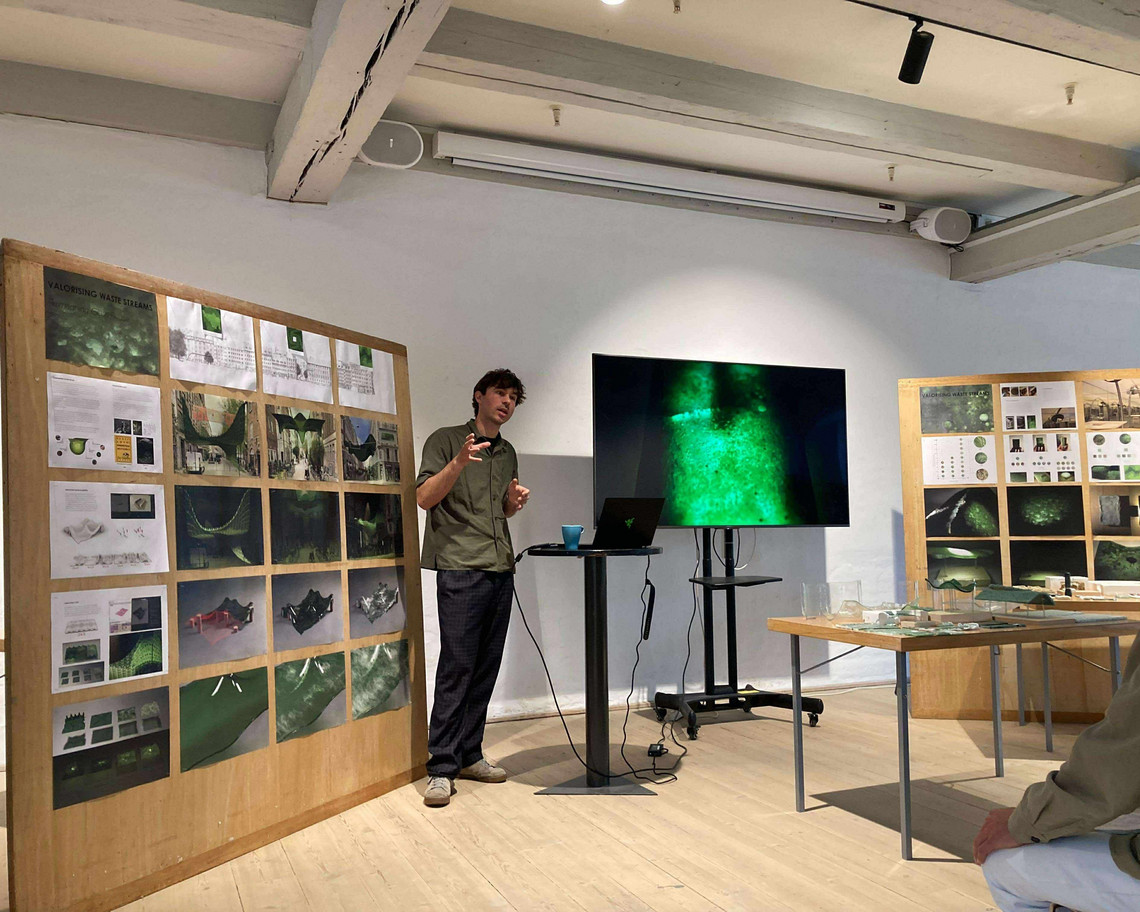
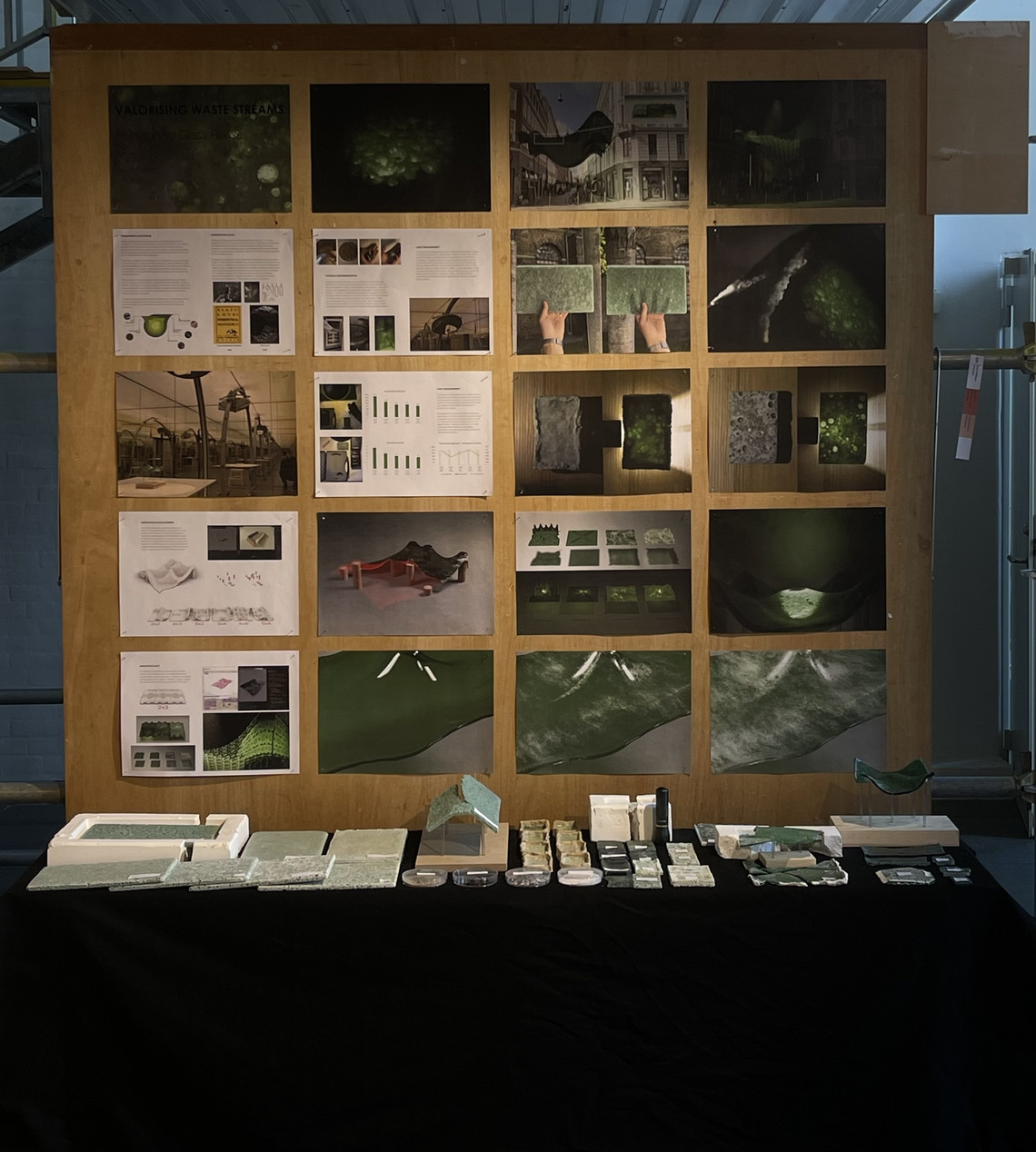
Valorising Waste Streams explores how contaminated waste glass powder and mussel shells can be transformed into slumped glass panels. Using light data and custom simulation tools, the project designs a vaulted arcade where panels are placed for optimal environmental and aesthetic performance.


Valorising waste streams reimagines glass waste as a viable architectural material, responding to Denmark’s evolving recycling landscape and the need for circular building practices. While Denmark maintains a relatively high rate of glass recycling, the potential for meaningful reuse, particularly within architecture, remains largely untapped. This project addresses that gap by developing a method for transforming contaminated glass waste that has fallen out of circularity into light-responsive architectural elements.
Central to the investigation is the combination of two waste streams: contaminated glass and mussel shells. The calcium-rich shells are upcycled into calcium carbonate, enabling experimentation with glass composition and performance. This material research supports a broader ambition to propose an alternative reuse system that aligns with upcoming Extended Producer Responsibility (EPR) regulations by redirecting packaging waste into architectural production.
The design outcome is a slumped glass roof structure that operates as both a material proof of concept and a spatial exploration. Developed through iterative digital and physical simulations, each glass panel responds to light in a distinct way, refracting, diffusing, and casting shifting patterns across the space. By day, the structure harnesses natural light to animate the interior. By night, it becomes a glowing artefact illuminated from within, revealing the complexity of its geometry.
Through this synthesis of waste valorisation, material research and light-focused design, the project positions glass not merely as a transparent enclosure but as an active architectural medium. It transforms waste into structure, and structure into atmosphere.


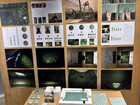
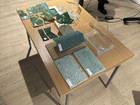
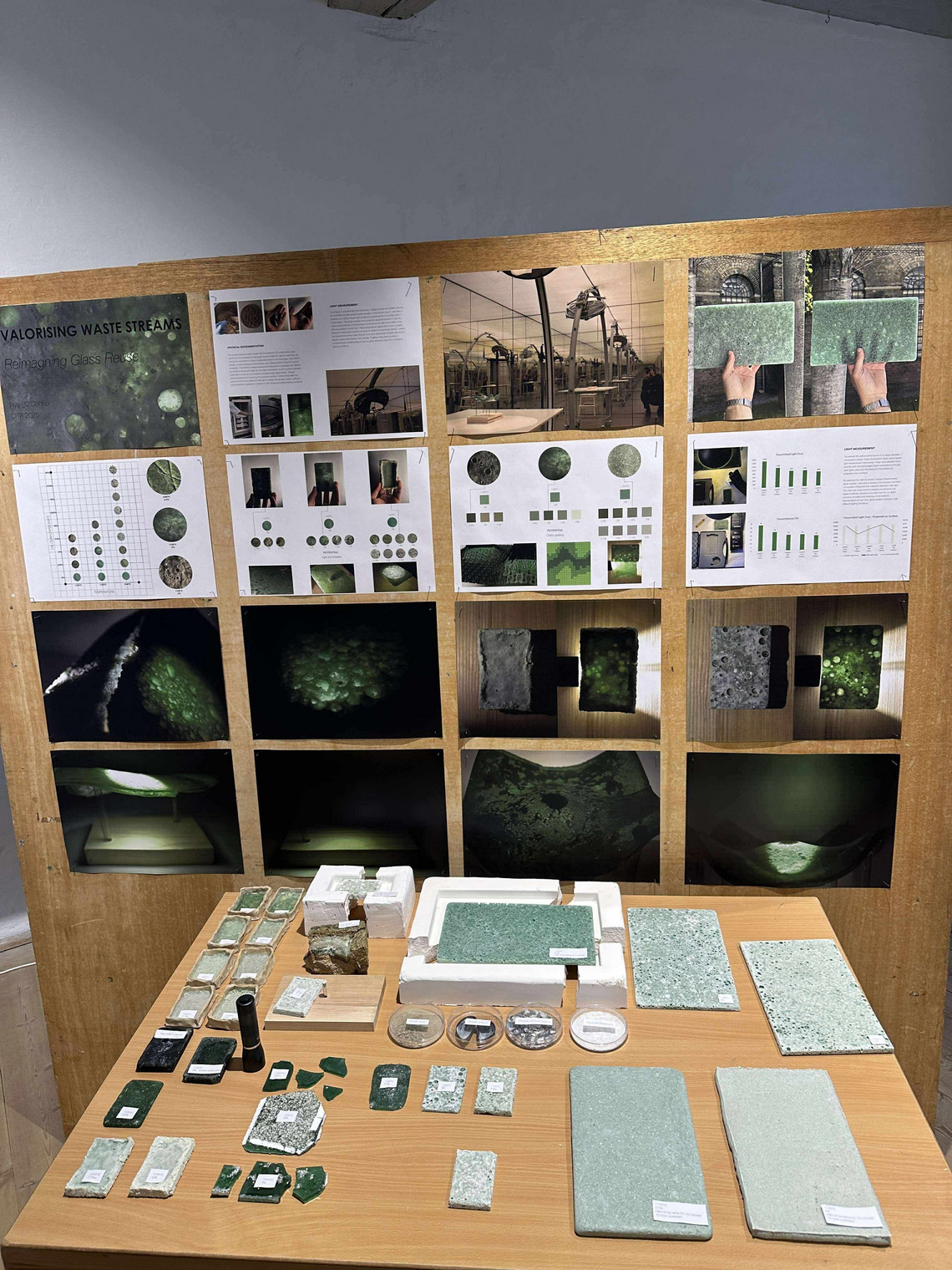
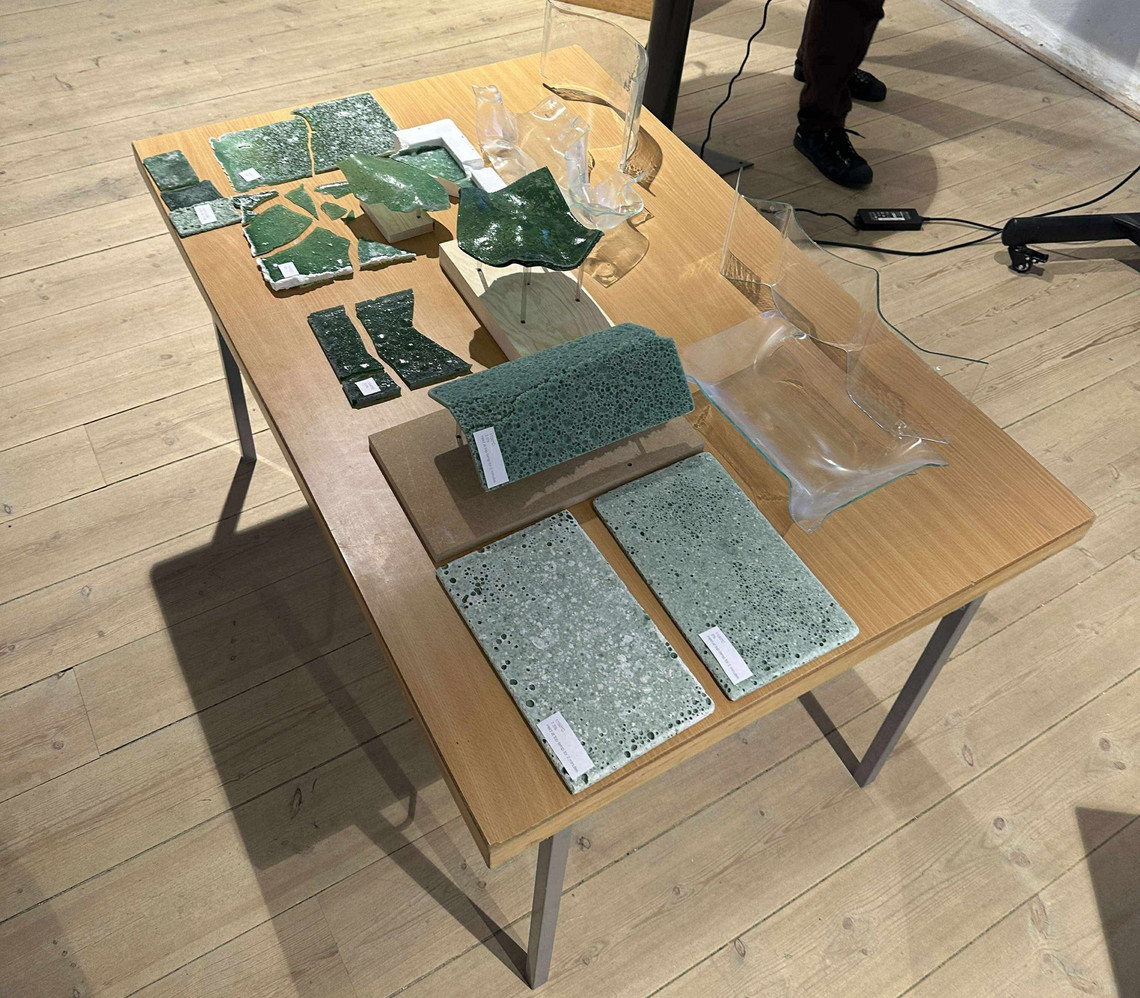
My physical experimentation began with the refinement of contaminated glass waste and the processing of discarded mussel shells into calcium carbonate. By varying the proportion of calcium carbonate added to the base glass, I was able to develop a wide catalogue of test recipes, each offering distinct visual and optical properties. This iterative material development allowed me to evaluate how different formulations influenced clarity, tint and light transmission. As the results progressed, I was able to scale up my process to produce larger glass sheets. Through post-processing techniques such as surface sanding, I further manipulated the glass to enhance its interaction with light to reveal new textures, levels of diffusion and atmospheric qualities for analysis in both natural and artificial lighting conditions.




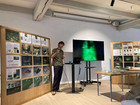
To conduct my physical light recording tests, I utilised the light lab facilities, allowing for controlled and site-specific experimentation. Using the sun room, I was able to simulate and capture natural light conditions by geolocating to my project site in Copenhagen. This setup enabled me to study the seasonal variations in light by capturing the intensity and sharpness of summer sun as well as the softer, more diffused qualities of winter light. These observations helped inform how my glass performs in real-world contexts over time. In addition to natural light testing, I used a dark studio environment within the lab to conduct artificial light analysis, allowing for precise control over direction and intensity. Together, these tests provided a comprehensive understanding of how my glass elements respond to contrasting lighting conditions.

To evaluate the optical performance of my glass samples, I conducted a series of light transmission tests using Hagner light measurement instruments. These tools allowed me to quantify both the percentage of light transmittance through each glass piece and the amount of transmitted lux projected onto a surface.
By applying this method across a range of experimental glass recipes, I was able to assess and compare how each composition influenced the material’s interaction with light. This data was instrumental in bridging my physical and digital workflows, providing accurate input for my digital slumping simulator and enabling a more precise representation of how each glass variation behaves under different lighting conditions.


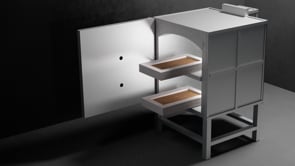
I began by conducting physical slumping tests on control glass samples in order to better understand the material’s behavior at high temperatures and to calibrate a digital slump simulator. These experiments provided valuable insight into how glass deforms under heat and gravity, but initial attempts to replicate these results using a simulator in Blender revealed limitations in accuracy. To address this, I developed a custom simulation workflow in Grasshopper. By scripting an algorithmic system that dynamically distributes and varies the height of support structures, I was able to calibrate both the rigidity of the glass sheet and the influence of gravity. This approach resulted in a high-fidelity simulation capable of predicting glass deformation and flow at 700 °C with a level of precision suitable for both design development and fabrication planning.


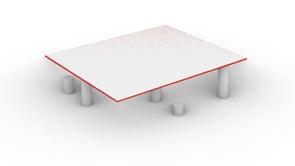


Building on the calibrated simulation developed in Grasshopper, I went on to develop a custom Blender plugin that bridges the two platforms by using Grasshopper as the engine to drive the simulation, and Blender as a visualiser for rendering the material and optical behaviour of glass. By embedding accurate lux measurements into the Blender environment, the system enables a faithful representation of my physical glasswork in digital space. This allows me to simulate the intricate play of light refraction and dispersion with a level of visual and optical precision that mirrors real-world conditions. In doing so, I’ve created a workflow that not only supports design and fabrication, but also captures the distinctive luminous character that defines my glass practice.
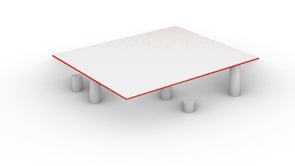
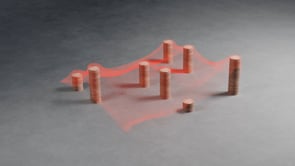


With this integrated simulation and visualisation workflow in place, I was able to explore a wide range of design possibilities through digital experimentation. By manipulating variables such as support geometry, slump duration, and temperature curves, I could rapidly test and iterate different configurations of slumped glass panels in a controlled virtual environment. This not only expanded my creative vocabulary but also enabled a more deliberate and informed approach to form-making, where each design decision is grounded in an understanding of material behaviour and optical performance. The ability to preview how glass will deform and interact with light before fabrication has become a powerful extension of my studio practice, allowing for greater precision, risk-taking and innovation in the design process.


Bringing together the simulation workflow and material research, the project culminates in a proposal for a glass arcade roof on Blågårdsgade, a lively and densely layered street in central Copenhagen. The intervention reimagines an overlooked urban void as a covered public thoroughfare, using slumped glass panels made from reclaimed waste to create a canopy that modulates light, frames the sky, and responds to the shifting rhythms of the street below. Along its length, the proposal introduces three distinct roof conditions, each calibrated to the spatial and social qualities of the street it spans. These variations respond to factors such as circulation patterns, solar exposure, and adjacent building uses, creating moments of openness, enclosure, and filtered light.
The design leverages the calibrated digital tools developed earlier, allowing each panel to be shaped in relation to its structural support and solar orientation. As a result, the roof performs not only as a climate-responsive architectural element but also as a material expression of circular design, embedding local waste into the fabric of the city in a way that is both spatially and environmentally meaningful.