A

Digital Anschuhen explores robotic timber repair through analysis, simulation, and fabrication. Using scans of damaged beams, the project generates graft geometries that respond to the different damage cases. Bridging traditional joinery and robotic milling, it proposes a workflow of care, memory, and craft reimagined.

Anschuhen [ˈanˌʃuːən]
A traditional carpentry technique for repairing timber by grafting a new piece onto a damaged section, typically using precise joinery to restore structural integrity.
Fachwerkhaus [ˈfaxvɛʁkˌhaʊ̯s]
A traditional timber-framed house built with a structural wooden frame and infilled panels of brick, adobe bricks, wattle and daub, or plaster.
Germany is home to an estimated 2.4 million Fachwerk buildings that represent a significant part of the country's architectural and cultural heritage. Of these, around 25% are protected heritage sites with strict protections and regulations. Roughly 30% of the total Fachwerk buildings stand vacant, often leading to a state of disrepair due to a lack of maintenance. At the same time, there are only about 5,000 trained craftspeople nationwide who specialize in the traditional timber construction techniques needed to maintain and repair these structures. This severe shortage of skilled labor poses a growing threat to the long-term preservation of these buildings.
As more Fachwerk buildings fall into disuse and decay, the pressure to find scalable, precise, and adaptive repair solutions becomes urgent. Traditional methods are time-intensive and dependent on a shrinking pool of expertise. This is why it is crucial to develop a repair method that combines traditional knowledge with digital analysis and robotic fabrication to support craftspeople, extend their capabilities, and make the restoration of timber architecture more accessible and sustainable.


When assessing the impact of a repair operation, it’s important to consider the cultural and architectural value of the existing structure. Some buildings demand a high degree of care and precision due to their heritage significance, where even small interventions carry weight. Others, while typologically similar, are not under such strict protections and sit outside the boundaries of formal preservation. These offer space for experimentation, where repair can become a tool not just for conservation, but also for transformation. The matrix diagram reflects this range: from careful restoration to adaptive reuse, it helps position repair as both a protective and progressive act within the architectural landscape.

Disrepair is rarely a sudden event. It may emerge in a moment or unfold quietly over many years. In the same way, maintenance and repair are not fixed points in time but rather recurring actions that respond to shifting degrees of urgency.
We can outline a spectrum of approaches, splitting them into anticipatory to reactive measures. Proactive maintenance intervenes before damage can form, addressing root causes early on. Predictive strategies rely on careful observation and data to foresee and prevent failure. Condition-based responses arise the moment a fault is detected, enabling real-time intervention. Reactive repair, by contrast, responds to slow-developing issues like moisture or rot, only acting once the damage is visible. Curative repair operates at the furthest end of this spectrum, where time has passed and the focus is on restoring what was lost.
This layered understanding emphasizes that care for buildings is not a one-time event, but an ongoing dialogue with their material state. It relies on a deep understanding of materiality, structural performance, and craft in order to make educated decisions on when and how to intervene.

I consider the workflow as an iterative process, where each repair builds on the insights of the last. Data is gathered, tested, and refined over time, allowing for continuous improvement. Rooted in the knowledge of architects and craftspeople, each intervention becomes an opportunity to learn through observation, reflection, design, and simulation. As more repairs are carried out, the process evolves, becoming more precise, informed, and responsive to the material and its behavior.

In more detail, this means that once damage has occurred, a craftsperson will do an initial visual assessment in order to classify the damage at hand. Based on the damage case, the right type of surveying method can be chosen to gather the necessary data in a digital model of the damage. This model can then be used for a secondary assessment, which is performed on the digital model. This assessment will inform the design choices in the next step, where design and simulation are used in a feedback loop to generate the best possible repair geometry, which can be fabricated in the final step of the workflow.

The next step was to scale up the approach and simulate a 1:1 scenario within a Fachwerk building where damage might realistically occur. To do this, three timber beams were selected, each with different types of damage, ranging from biological to mechanical, keeping them in their original spatial orientations, while mirroring their real-life contexts. This informed the development of a repair prototype, where the location and type of damage followed a clear internal logic. It also allowed for practical experiments on the reach and positioning of the robot for potential on-site repair operations.


The scanning process was carried out using a ZIVID structured light scanner mounted on a robotic arm. This setup enables a flexible workflow in which the robot captures a scan, repositions, and captures again, repeating the process until the object has been fully documented from all necessary angles. The repositioning can be done either manually or through automated path planning, with live visual feedback guiding the user to fill in any gaps. This iterative approach allows for on-the-fly refinement, ensuring high-quality, complete scans.
Each scan captures both geometric and color data, resulting in a dense, textured point cloud that can be imported directly into processing software. Because the scanner is mounted on the robot, the position of the scanner is known for every capture. This allows the individual scans to be automatically aligned in space, removing the need for time-consuming manual registration and enabling a streamlined, autonomous scanning workflow.
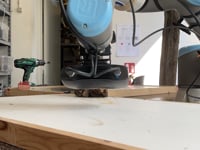


Resistance drilling is a manual surveying technique used to assess the internal condition of timber by measuring the resistance encountered as a fine drill bit penetrates the wood. Areas affected by rot offer significantly less resistance, allowing the operator to identify zones of internal degradation that may not be visible from the outside. This method is especially useful for mapping the extent of hidden damage and guiding more targeted digital scans or repair strategies.


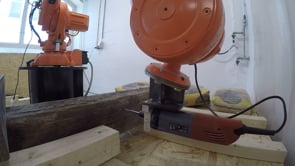
The experiments were fabricated using robotic milling, allowing for the precise removal of damaged timber and creating custom repair geometries. Robotic milling offers high complexity, precision, and flexibility, but it is not always the most time-efficient method, especially for straight cuts or deep removals, where robotic bandsaws or circular saws could be more effective. However, when working with on-site robotics, the choice of end-effector is shaped by constraints such as size, weight, and reach, all of which influence what kind of tool can realistically be deployed in the field.

When working with straight-cut geometries such as pockets, extracting the individual faces of the timber element is useful to isolate the faces required to reconstruct the geometry. The scan produces a point cloud, which can be analyzed to determine the orientation of each point in space, known as a normal vector. By comparing the normal vectors of neighboring points, it is possible to cluster them into distinct faces of the beam. This method also reveals subtle details such as cracks and surface deformations. Once the relevant faces have been identified, they can be isolated and enclosed within a bounding box, defining the pocket geometry based on the maximum extents of the clustered points.


Because milling allows for the fabrication of highly complex geometries, the next step was to explore a more customized approach to repair, one that moves beyond traditional forms and instead responds directly to the shape and extent of the damage. In this experiment, the focus was on a mechanical failure: a broken tenon joint on a diagonal bracing element. The repair geometry was generated to match the extent of the break, aiming to restore the structural integrity of the element while removing as little material as possible but still ensuring a precise and effective fit.


Here, the point cloud is analyzed using both color data and geometric characteristics to locate and interpret the damaged region. Points can first be filtered based on color variation – often indicating material loss, burn marks, or aging – and then further refined by assessing the shape and irregularity of the surface. Once the relevant area has been isolated, a mesh can be generated to enclose the selected points, forming the basis for a repair geometry. This approach allows for the reconstruction of the missing parts of the tenon joint with a high degree of accuracy and control.


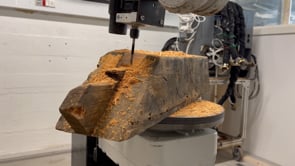
In traditional timber construction, craftspeople often inscribed Roman numerals, known as Abbundzeichen, into timber elements to ensure that matching joints could be correctly reassembled on site. These markings, still visible in many historic structures, served as a physical system of orientation and memory.
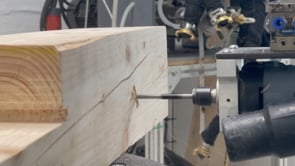
Using robotic fabrication, we can create similar inscriptions in a fraction of the time. While bespoke repair elements only fit in one specific location, making positional markings unnecessary, we can repurpose this method to embed other forms of knowledge directly into the timber. Instead of indicating assembly, these markings can record when the repair was made, what type of damage prompted it, or the condition of the element at the time. Unlike traditional tools, robotic milling allows for far greater complexity, enabling the use of symbols, letters, numerals, or even custom-designed runes. There is even potential for creating scannable codes, linking the physical repair to a digital archive of metadata, including images, scans, and design documentation.

In the example below, the beam was repaired due to rot. The damage had developed over time, compromising the integrity of the wood and prompting a targeted intervention. The repair was carried out in the year 2025, and this information is now etched into the timber itself. Using the symbolic system developed for marking repairs, we assigned a specific symbol to indicate rot. Combined with the year, the marking reads: 𐌙25. This compact inscription serves as a physical record of both the cause and timing of the repair; accessible not through external documentation, but embedded directly in the material.



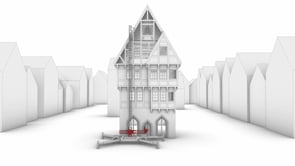
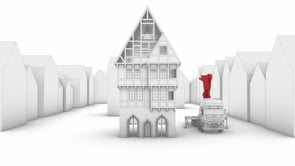
Implementing on-site robotics for timber repair requires careful consideration of access, stability, and flexibility. Existing buildings present complex geometries and unpredictable conditions, making mobility and reach critical factors in the design of any robotic setup. Several scenarios were explored to understand what it takes to bring robotic fabrication directly to the facade. Two examples are shown—each chosen for their ability to navigate specific spatial challenges, such as traversing across a wall surface or reaching into tight, elevated areas beneath rooflines. These examples illustrate how robotic systems can be adapted to meet the diverse demands of in situ repair.