


A

During 3daysofdesign, you can experience The Agora Project: a series of ceramic pieces placed along the harbourside, made from crushed construction waste. Behind the project are Nina Erichsen, Head of Programme for Ceramics, and Jacob Bang, Associate Professor and Head of the Bachelor Programme Whole and Part - an unusual but rewarding collaboration.
At the intersection of architecture and craft, Nina Erichsen and Jacob Bang have developed a practice where collaboration is not just a method of working, but the very driving force of their process. Here, ideas do not emerge as finished concepts; they take shape in the meeting between materials and disciplines - often in the process itself.
Their collaboration at the Royal Danish Academy dates back several years and stems from a desire to work across disciplines.
'We started by creating joint workshops for our students, mixing ceramics students and architecture students,' says Jacob Bang.
For Nina Erichsen, the shared focus on form is essential: 'Both Jacob and I are deeply engaged with form - both in the object itself and in its surroundings. In our teaching, an important premise emerged: that our collaboration was not about eliminating differences, but about working productively through them.'


From a teaching perspective, the project has been crucial in giving students a more embodied understanding of method:
'Standing there and thinking together with the material - with both hands and mind - is an important realization,' says Nina Erichsen.
The workshop as a shared space
What began as a workshop format has evolved into an ongoing practice. In the work of Nina Erichsen and Jacob Bang, materials are not passive - they are active collaborators. Decisions are made in dialogue with the material, and outcomes are never entirely predictable.
As clay is increasingly becoming a limited resource, they explore the potential of clay-based construction waste. This can include discarded bricks, roof tiles, ceramics, or porcelain, all repurposed into new products. The waste is crushed into particles ranging from 0.5 to 50 mm in size, then mixed with fresh clay as a binding agent.
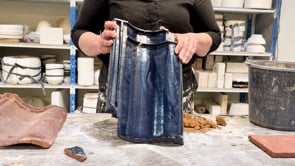
Together, they experiment with different material compositions depending on the type of object.
'There is a framework, but from there it can unfold,' as Nina Erichsen puts it.
This openness to the inherent logic of the material is particularly evident in their work with crushed materials - a method that carries both aesthetic and sustainable dimensions.
'There is so much waste in the world, so we started looking at what we can use without necessarily extracting new clay,' explains Nina Erichsen.
Jacob Bang highlights how this shifts both practice and perspective. The material carries traces of its own history - something that adds meaning to the process:
'There is a certain poetry in using, for example, a discarded roof tile that once had a function, crushing it, and allowing it to re-emerge as a new building element in a poetic and aesthetic form, carrying traces of its past,' he says.

Experiments in the workshop
The workshop is one of the most important frameworks for their collaboration. Here, the process is driven not by theory, but by action, repetition, and experimentation.
'It is not a laboratory. It is a workshop where we work with specific, well-tested processes,' explains Nina Erichsen.
This creates an open environment where teaching and development take place side by side. Jacob Bang describes it as a conscious strategy:
'It is quite remarkable to work in a workshop where we do not begin with a fixed plan. We are constantly making decisions: ‘now we go this way’ or ‘we drop this idea.’ The process is not linear - it is shaped by shifts, by choices and rejections. We make mistakes and adjust. All of these decisions become part of the learning,' he says.
For both of them, collaboration is not a project with a clear endpoint, but an ongoing investigation. The Agora Project is driven by a desire to create, experiment, and learn together - and by a fundamental joy in the process: 'It becomes a practice where seriousness and play, hand and mind, structure and chance merge - and where the most important thing is not to arrive at an answer, but to keep asking questions along the way,' says Jacob Bang.
Their collaboration is characterised by openness, trust, and generosity. It is not about defending individual ideas, but about developing something together - and even communicating without words:
'How do we build on each other’s ideas, and how do we make each other better? Sometimes we work together without words. There is something about proportions and compositions that is wordless,' says Nina Erichsen.
This approach creates a working method where experimentation, mistakes, and chance are not obstacles, but essential conditions.
From object to space
Some of their experiments have previously been exhibited in gallery contexts, including at the Royal Danish Academy in Copenhagen, Form/Design Center in Malmö, and Grønbechs Gård in Hasle.
In their current work, they move from individual objects toward larger spatial contexts. This development blurs the boundaries between sculpture, furniture, and architecture.
'The spatial objects can be very abstract at times, but at other times they become concrete benches or columns. It is about how the object can create a new situation in public space,' explains Nina Erichsen.


About The Agora Project
Using reused materials such as recycled bricks, crushed roof tiles, and glass waste, the Agora Project creates benches and small meeting places in the urban landscape. These spaces function as contemporary metaphors for the fireplace and the well. Places to gather, pause, and connect.
The project explores how architecture and craft can support community and wellbeing, particularly for elderly people, vulnerable individuals, and those living at the margins of society. Rooted in local collaborations and conversations with residents, each intervention responds to the history, materials, and everyday life of its site.
The Agora Project is an example of artistic research developed through a close collaboration between craft and architecture, grounded in principles of universal design.
Supported by Gamle Mursten (Svendborg), and VM Mørtel (Vrå).


